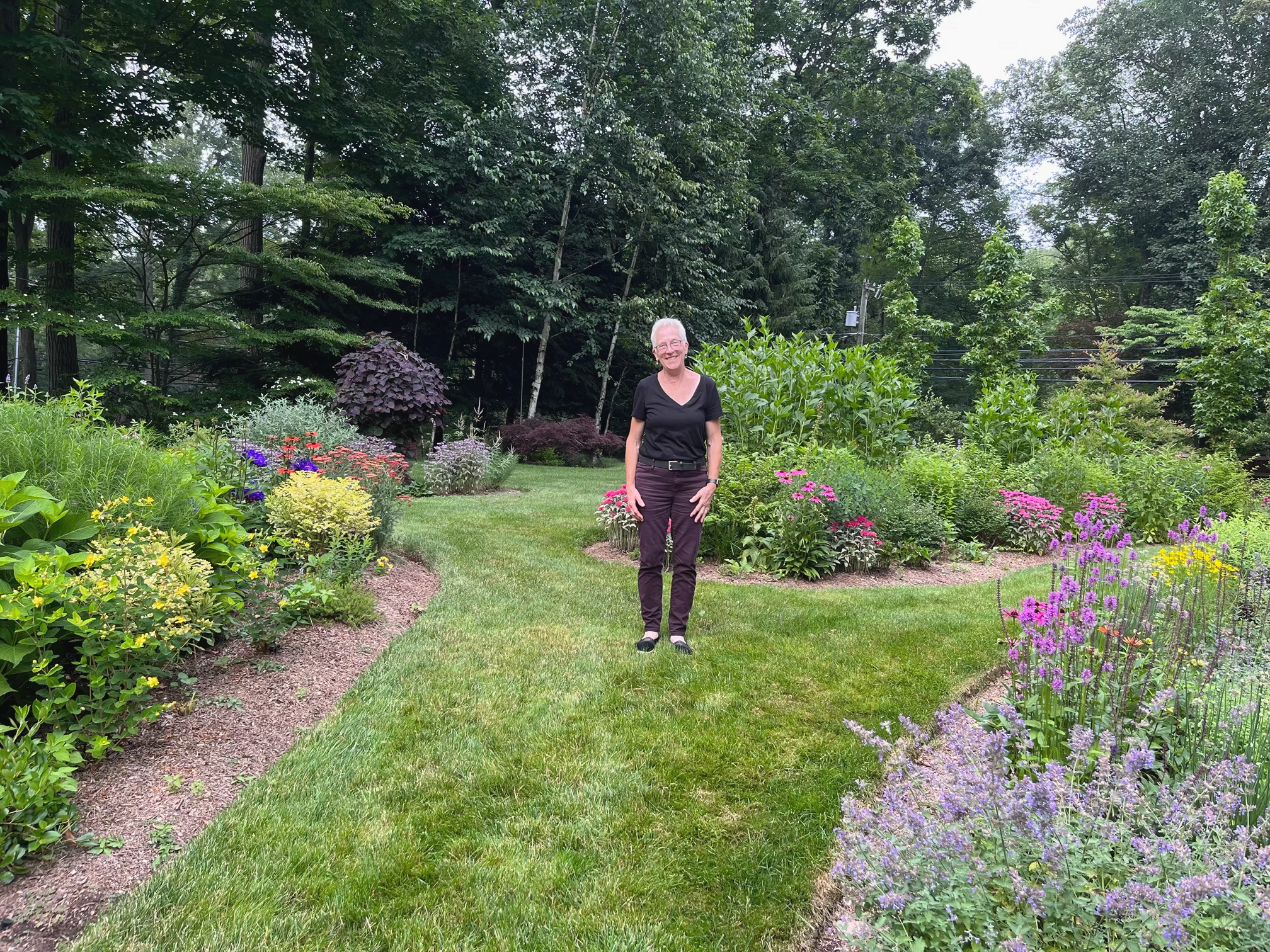
I’m Janet Chakwin, owner of Bettswood Gardens.
I’ve made gardens and designed landscapes professionally since 1992.
Like many a designer, I came to this career after a very different first one.
Raised in a small, woodsy town, surrounded by artists, intellectuals and gardeners, I chose a liberal arts route for college. Married. Then on a whim and a dare, I became a lawyer. Three kids later, art and design and the natural world won, and I pivoted.
I studied at the New York Botanical Gardens, local arboreta, and countless independent programs. Collected two hard-won certifications early on: first a from CNLA, (the Connecticut Nursery and Landscape Association) as a CT Certified Horticulturist, and next from CT DEEP (Dept of Energy and Environmental Protection) as an arborist—specifically as a Supervisory Arborist—the kind that can legally climb and spray and cable and all those things that of course I was never going to do. I just wanted to learn about trees so I would be a better designer.
In all my work, connection to place, and to the earth itself, matters.
A common definition of a designer’s role is to marry form and function in a way that adds beauty to the world. For me, the work also has a deeper purpose: to reconnect us to the natural world we live in. The spaces we inhabit, move through, and care for affect us more than we often realize. They can nurture and heal. They can enliven and stimulate.
We, in turn, affect the landscapes we live in. We can nurture and heal as well, but only if we recognize that we are part of a larger community. Nature is not something separate from us. We are within it, and it is within us.
It may sound simple, but it remains true: we all live downstream.
Landscape design is, in some ways, a misnomer. It becomes one if we imagine that a garden is ever finished or fixed. In reality, it is a living system, always changing. What we create is never the same twice. Gardens evolve through the daily, seasonal, and yearly interplay of light, color, texture, and form.
It is often called the slowest art, and that may be its greatest strength.